
Most website owners think about SEO in terms of keywords, backlinks, and content. But there is a layer underneath all of that which quietly determines whether Google even considers your page worthy of a top spot in Core Web Vitals.
These are real, measurable performance signals that tell Google and increasingly AI search platforms whether your page actually delivers a good experience. Not a theoretically good experience. A good experience for real users on real devices in real network conditions.
Ignore them, and your content competes with one hand tied behind its back.
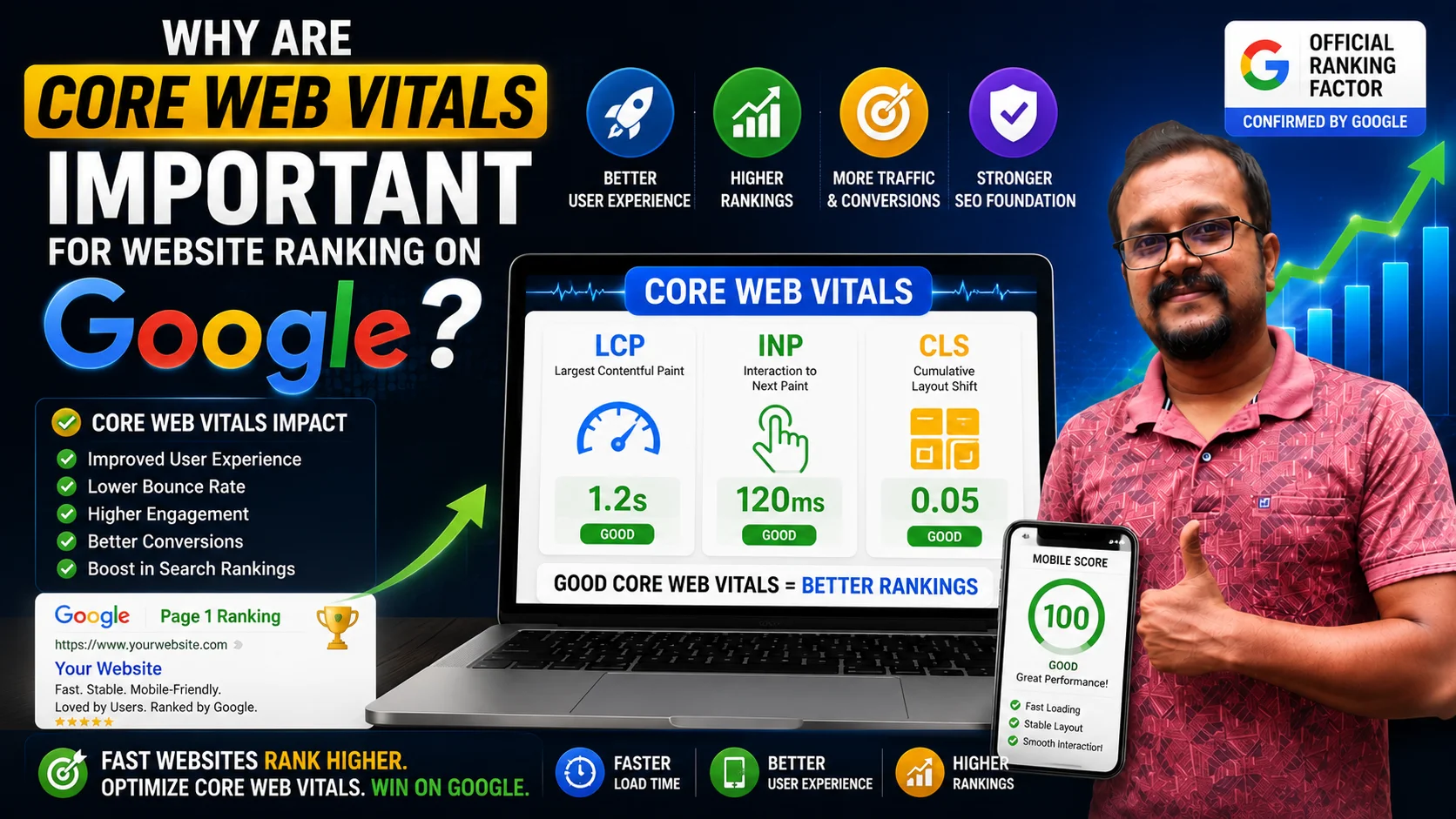
Table of Contents
ToggleWhat Are Core Web Vitals?
Core Web Vitals are three specific metrics. Google uses to measure real-world page experience. They are not any opinions, they are numbers, collected from actual Chrome users through the Chrome User Experience Report (CrUX).
Google rates each metric as Good, Needs Improvement, or Poor. To pass Core Web Vitals, at least 75% of your real visitors must score “Good” on all three metrics.
The three metrics are the following:
-
LCP — Largest Contentful Paint measures how quickly your main content loads, typically a hero image or headline. Target under 2.5 seconds.
-
INP — Interaction to Next Paint measures how quickly your page responds to user interactions, clicks, taps, and keyboard inputs. Target: under 200 milliseconds. INP replaced First Input Delay (FID) in March 2024. Any guide still listing FID is outdated.
-
CLS — Cumulative Layout Shift measures how much the page layout jumps around while loading ads appearing, images shifting, and fonts swapping. Target: under 0.1.
A critical detail most articles skip is that Core Web Vitals use field data. Google grades you on CrUX at the 75th percentile across a 28-day rolling window. A perfect Lighthouse score in your dev tools means nothing if real users on mid-range phones get slow results.
That last point matters enormously for businesses targeting users in India, where mid-range Android devices and variable network speeds are the norm, not the exception.
What Are Core Web Vitals Scores?
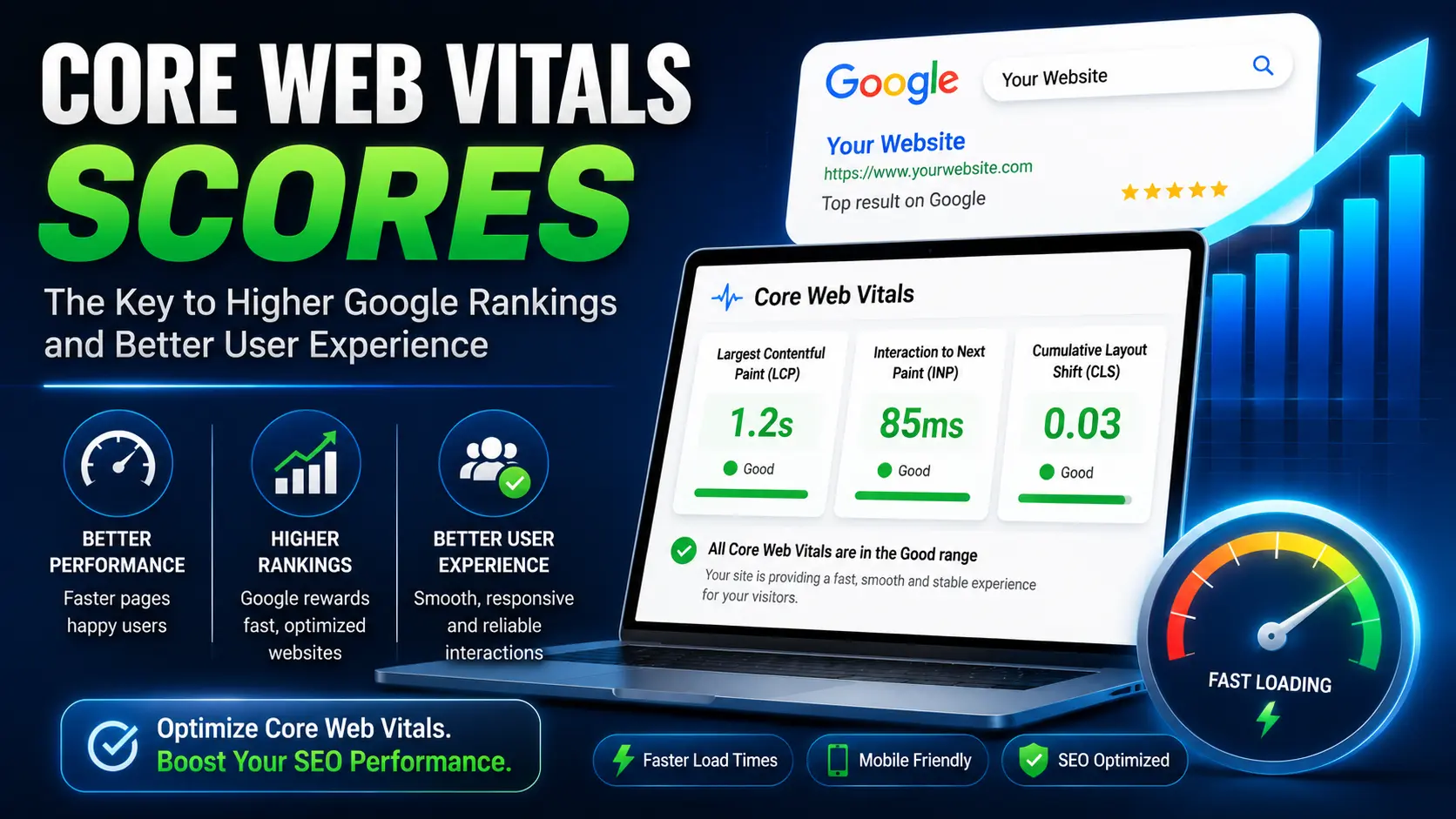
As of the May 2026 CrUX release, 55.9% of all tracked origins pass all three Core Web Vitals. The individual metric pass rates were: 68.6% good LCP, 81.3% good CLS, and 86.6% good INP.
Broken down by device:
57.1% of websites pass Core Web Vitals on desktop, compared to only 49.7% on mobile (DebugBear, October 2025 CrUX data).
Scoring thresholds at a glance:

Important Core Web Vitals Tools
You can’t improve what you don’t measure. These are the tools that matter:
-
Google Page Speed Insights — Free. Shows both lab (simulated) and field (CrUX) data for any URL. The field data tab is what Google actually uses for ranking signals.
-
Google Search Console — Core Web Vitals Report — Shows which pages are “Good,” “Needs Improvement,” or “Poor” based on real user data. Groups pages by issue type, making prioritization straightforward.
-
Chrome Dev Tools — Developer-facing tool for diagnosing LCP, INP, and CLS at the element level. Useful for finding the specific resource causing the failure.
-
Lighthouse — Built into Chrome DevTools. Runs a lab simulation of your page and provides scored recommendations. Use it for diagnosis, not as a proxy for your real CrUX score.
-
CrUX Dashboard — Google’s own Chrome User Experience Report dashboard. Shows historical field data at the origin level. Excellent for tracking trends over time after you make changes.
-
One important note: CrUX updates on a rolling 28-day window. If you fix an issue today, it takes approximately a month for Google Search Console to fully reflect the improvement. Don’t panic when the report looks unchanged in the first few weeks after a fix.
Why Are Core Web Vitals Important?
Core Web Vitals are important for user experience and search engine ranking. It is a technical SEO essential work that matters for website performance and getting better rankings on SERP.
Pages loading within 2 seconds have a 9% bounce rate. Pages taking 5 seconds see bounce rates jump to 38%.
A user who bounces in four seconds doesn’t convert. They don’t book. And they send a behavioral signal back to Google, confirming that your page wasn’t worth their time, which reinforces lower rankings.
In an A/B test run by Vodafone Italy on two otherwise identical pages, a 31% improvement in LCP drove 8% more sales (web.dev case study). A contact form that lags on submission, a hero image that shifts as it loads, or a slow mobile page are silent conversion leaks.
70% of users cite visual stability as critical to their trust in a website experience. CLS isn’t just frustrating; it destroys the confidence visitors need before they purchase.
Every 100ms of load time costs approximately 1% in conversions. For a business generating ₹1 crore annually, a 500 ms improvement translates to roughly ₹5 lakh in recovered revenue, not theoretical but derived from aggregated A/B test data.
Do Core Web Vitals Directly Improve Google Rankings?
Yes, Core Web Vitals directly improve website rankings on Google SERP.
Core Web Vitals are a confirmed Google ranking signal, but they act as a tiebreaker between pages of similar relevance rather than overriding content quality. Content authority and backlinks remain fundamental, but Core Web Vitals can tip the scales in a competitive SERP.
Core Web Vitals matter most in competitive niches where content quality between top-ranking pages is similar. When two pages cover the same topic with similar authority, the faster, more stable page wins.
The practical reality for most Kolkata businesses: your competitors’ websites are often technically average. Passing Core Web Vitals when they don’t is a direct ranking advantage that requires no new content, just proper optimization.
How Do Core Web Vitals Affect AI Overview Visibility?
This is the part most guides haven’t caught up to yet.
Early analysis suggests sites with healthy Core Web Vitals show a 3 to 4 times higher citation rate in AI-generated answers compared to slow sites in the same topic area. Performance now influences whether your content is referenced at all, not just where it ranks.
The mechanism is logical. AI crawlers GPTBot, PerplexityBot, and Google-Extended prioritize fast, well-structured, stable pages when deciding what to read and what to surface. A slow page with layout shifts isn’t just a poor user experience. It’s also a poor machine experience, and AI systems reflect that in their citation decisions.
Analytic platforms tracking AI traffic confirm that sites passing all three Core Web Vitals consistently receive more citations from ChatGPT, Perplexity, Claude, Gemini, and Copilot compared to underperforming sites in equivalent topic areas.
In 2026, Core Web Vitals optimization isn’t just for Google SERP rankings. It is for AI overview appearances too.
Why Do I Prioritize Core Web Vitals as an SEO Service Provider?
Because I have seen repeatedly what happens when good content sits on a slow, unstable website.
The businesses I work with in Kolkata are competing in markets where every enquiry matters. A dental clinic in Newtown, an interior design firm in Salt Lake, and a legal consultancy in Park Street, none of them can afford to lose 30% of visitors to a 4-second load time before anyone reads a word of their content.
The Kolkata market adds an extra layer of urgency. A significant share of local users access sites on mid-range Android devices via 4G connections. That is exactly the user profile where Core Web Vitals failures hit hardest, particularly LCP failures caused by unoptimized images and render-blocking scripts.
At Adrij SEO Expert, Core Web Vitals assessment is part of every initial audit I run. I check field data in Google Search Console, validate it against PageSpeed Insights, diagnose element-level failures in Chrome DevTools, and build a prioritized fix list before touching any content or link work. Because the foundation has to be clean before anything built on top of it will hold.
Common Core Web Vitals Problems I Find During SEO Audits
After auditing dozens of client websites in Kolkata, the same issues appear again and again:
LCP failures (most common):
Uncompressed images in PNG or BMP format where WebP would load 30–50% faster
Hero images are not preloaded, the browser discovers them late and loads them after everything else.
Slow server response times (TTFB over 600ms) are often a hosting problem, not a code problem.
Render-blocking CSS and JavaScript delaying the main content from painting
INP failures:
Heavy JavaScript executing on the main thread in response to user clicks.
Third-party scripts (chat widgets, ad networks, analytics tags) competing with user interaction handlers.
Excessive DOM size making interaction processing slower.
CLS failures:
Images without defined width and height attributes, the browser can’t reserve space before loading.
Ads injected after page load that push content down.
If font swapping, a fallback font displays, then the web font loads and causes a layout shift.
Cookie consent banners and popups appearing after initial paint.
43% of websites still fail the 200ms INP threshold in 2026, making it the hardest Core Web Vital to pass consistently.
My Experience as an SEO Expert in Kolkata
I’m Adrij, founder of Adrij SEO Expert, and Core Web Vitals have been part of my audit process since Google confirmed them as ranking signals in 2021.
In the early days, most clients pushed back on the technical work. “Just fix the keywords” was a common instruction. That changed when I started showing them their bounce rate data alongside their LCP scores. A service page with an LCP of 4.8 seconds and a 62% bounce rate tells its own story, and the fix for that story isn’t more blog posts.
One case that sticks with me: an interior design client in Kolkata had good content and decent backlinks but wasn’t breaking the top 10 for their primary service keywords. The Google Search Console Core Web Vitals report showed 87% of mobile URLs in “Poor” status. The culprit was a slideshow plugin loading 14 uncompressed images sequentially at page load, an LCP of 6.2 seconds on mobile.
Removing the slider, switching to a single optimized hero image in WebP, and adding preload those three changes alone brought LCP to 1.9 seconds. Within six weeks the page moved from position 14 to position 6. The content hadn’t changed. The backlinks hadn’t changed. The technical foundation had.
That is the lesson I carry into every audit at Adrij SEO Expert. Fast and stable pages are not a development luxury.
FAQs
Are Core Web Vitals a confirmed Google ranking factor?
Yes, Google incorporated Core Web Vitals into its page experience signals in June 2021. While content relevance remains the primary ranking factor, Core Web Vitals serve as a benchmark and can be the main differentiator in competitive SERPs where multiple pages cover similar topics with similar authority.
What is the current pass rate for Core Web Vitals in 2026?
As of the May 2026 CrUX release, 55.9% of all tracked origins pass all three Core Web Vitals. Desktop pass rate is 57.1%; mobile is 49.7%. Over half of the mobile web is still failing.
Which Core Web Vital is hardest to pass?
INP, 43% of websites still fail the 200ms threshold in 2026, making it the most commonly failed metric. LCP is close behind only 68.6% of origins have good LCP scores.
How long after fixing Core Web Vitals will I see ranking improvements?
CrUX uses a 28-day rolling window, so Search Console data takes approximately one month to fully reflect your changes. Ranking movement typically follows within 4 to 8 weeks of the field data improving, though timelines vary by site authority and niche competition.

Prithu Roy Chowdhury – Founder of Adrij SEO Expert
SEO Freelancer and Digital Marketing Expert, Website Development, Social Media Marketing, and Meta Ads.
6+ Years of Experience | 70+ Projects Completed and 2000+ Keywords Ranked
From Habra, West Bengal, India
Service Location: Habra and Kolkata, West Bengal, India, and worldwide.
5 Star Google Reviews ⭐⭐⭐⭐⭐
Industries Work Experience: Education, Beauty and Cosmetics, Real Estate, Health and Wellness, Technology, and more.